6. Appendix
GRI Index
| Declaration of Use | Quanta Computer has prepared its 2024 Sustainability Report in accordance with the GRI Standards. The reporting period covers January 1, 2024, to December 31, 2024. |
| Version of GRI 1 Used | GRI 1: Foundation 2021 |
| Applicable GRI Industry Standards | None |
A. General Disclosures
| GRI Standards | Applicable Standard | Disclosure Requirement | Report Chapter | Chapter Title | Page | Remarks |
|---|---|---|---|---|---|---|
| GRI 2: General Disclosures 2021 | 2-1 | Organizational details | 1.1.1 | Sustainable Management | 09 | |
| 2-2 | Entities included in the organization's sustainability reporting | - | About the Report | 01 | ||
| 2-3 | Reporting period, frequency and contact point | - | About the Report | 01 | ||
| 2-4 | Restatements of information | - | About the Report | 01 | ||
| 2-5 | External assurance | - | About the Report | 01 | ||
| 2-6 | Activities, value chain and other business relationships | 1.1.1 | Sustainable Management | 09 | ||
| 2-7 | Employees | 4.1.1 | Safe Workplace | 100 | ||
| 2-8 | Workers who are not employees | 4.1.1 | Safe Workplace | 100 | ||
| 2-9 | Governance structure and composition | 1.4 | Sustainable Management | 21 | ||
| 2-10 | Nomination and selection of the highest governance body | 2.1.1 | Operations and Governance | 33 | ||
| 2-11 | Chair of the highest governance body | 2.1.1 | Operations and Governance | 33 | ||
| 2-12 | Role of the highest governance body in overseeing the management of impacts | 1.4 | Sustainable Management | 21 | ||
| 2-13 | Delegation of responsibility for managing impacts | 1.4 | Sustainable Management | 21 | ||
| 2-14 | Role of the highest governance body in sustainability reporting | 1.4 | Sustainable Management | 21 | ||
| 2-15 | Conflicts of interest | 2.1.1 | Operations and Governance | 33 | ||
| 2-16 | Communication of critical concerns | 1.4 | Sustainable Management | 21 | ||
| 2-17 | Collective knowledge of the highest governance body | 1.4 | Sustainable Management | 21 | ||
| 2-18 | Evaluation of the performance of the highest governance body | 2.1.1 | Operations and Governance | 33 | ||
| 2-19 | Remuneration policies | 4.1.3 | Safe Workplace | 117 | ||
| 2-20 | Process to determine remuneration | 2.1.2、4.1.3 | Operations and Governance | 36、117 | ||
| 2-21 | Annual total compensation ratio | 4.1.3 | Safe Workplace | 117 |
2024 Disclosure
|
|
| 2-22 | Statement on sustainable development strategy | 0 | Chairman & Vice Chairman Message | 01 | ||
| 2-23 | Policy commitments | 1.2 | Sustainable Management | 14 | ||
| 2-24 | Embedding policy commitments | 1.3 | Sustainable Management | 16 | ||
| 2-25 | Processes to remediate negative impacts | 1.5.2 | Sustainable Management | 26 | ||
| 2-26 | Mechanisms for seeking advice and raising concerns | 1.5.1 | Sustainable Management | 23 | ||
| 2-27 | Compliance with laws and regulations | 2.1.4 | Operations and Governance | 41 | ||
| 2-28 | Membership associations | 2.3.3 | Operations and Governance | 57 | ||
| 2-29 | Approach to stakeholder engagement | 1.5.1 | Sustainable Management | 23 | ||
| 2-30 | Collective bargaining agreements | 4.1.3 | Safe Workplace | 117 |
B. Material Topic Disclosure
| GRI Standards | Applicable Standards | Disclosure Requirements | Report Chapter | Chapter Title | Page | Remarks |
|---|---|---|---|---|---|---|
| Material Topic | ||||||
| GRI 3: Material Topics 2021 | 3-1 | Process to determine material topics | 1.5 | Sustainable Management | 23 | |
| 3-2 | List of material topics | 1.5 | Sustainable Management | 23 | ||
| Information Security Management | ||||||
| GRI 3: Material Topics 2021 | 3-3 | Management of material topics | 2.5 | Operations and Governance | 64 | |
| GRI 418-1: Substantiated complaints concerning breaches of customer privacy and losses of customer data | 418-1 | Substantiated complaints concerning breaches of customer privacy and losses of customer data | 2.5.1 | Operations and Governance | 64 | |
| Customer Relationship Management | ||||||
| GRI 3: Material Topics 2021 | 3-3 | Management of material topics | 2.5 | Operations and Governance | 64 | |
| GRI 416: Customer Health and Safety 2016 | 416-2 | Incidents of non-compliance concerning the health and safety impacts of products and services | 2.5 | Operations and Governance | 64 | |
| GRI 417: Marketing and Labeling 2016 | 417-1 | Requirements for product and service information and labeling | 2.5 | Operations and Governance | 64 | |
| GRI 417: Marketing and Labeling 2016 | 417-2 | Incidents of non-compliance concerning product and service information and labeling | 2.5 | Operations and Governance | 64 | |
| Innovation in R&D and Low-Carbon Technologies | ||||||
| GRI 3: Material Topics 2021 | 3-3 | Management of material topics | 2.2.3 | Operations and Governance | 53 | |
| Risk Management | ||||||
| GRI 3: Material Topics 2021 | 3-3 | Management of material topics | 2.2.1 | Operations and Governance | 41 | |
| Corporate Governance | ||||||
| GRI 3: Material Topics 2021 | 3-3 | Management of material topics | 2.1.4 | Operations and Governance | 41 | |
| GRI 206: Anti-competitive Behavior 2016 | 206-1 | Legal Actions for Anti-competitive Behavior, Anti-trust, and Monopoly Practices | 2.1.4 | Operations and Governance | 41 | |
| Talent Development and Training | ||||||
| GRI 3: Material Topics 2021 | 3-3 | Management of material topics | 4.1.2 | Safe Workplace | 112 | |
| GRI 404: Training and Education 2016 | 404-1 | Average hours of training per year per employee | 4.1.2 | Safe Workplace | 112 | |
| 404-2 | Programs for upgrading employee skills and transition assistance programs | 4.1.2 | Safe Workplace | 112 | ||
| 404-3 | Percentage of employees receiving regular performance and career development reviews | 4.1.2 | Safe Workplace | 112 | ||
| Supplier Management | ||||||
| GRI 3: Material Topics 2021 | 3-3 | Management of material topics | 2.4.2 | Operations and Governance | 59 | |
| GRI 204: Procurement Practices 2016 | 204-1 | Proportion of spending on local suppliers | 2.4.2 | Operations and Governance | 59 | |
| GRI 308: Supplier Environmental Assessment 2016 | 308-1 | New suppliers that were screened using environmental criteria | 2.4.2 | Operations and Governance | 59 | |
| 308-2 | Negative environmental impacts in the supply chain and actions taken | 2.4.2 | Operations and Governance | 59 | ||
| GRI414: Supplier Social Assessment 2016 | 414-1 | New suppliers that were screened using social criteria | 2.4.2 | Operations and Governance | 59 | |
| 414-2 | Negative social impacts in the supply chain and actions taken | 2.4.2 | Operations and Governance | 59 | ||
| Human Resource Management | ||||||
| GRI 3: Material Topics 2021 | 3-3 | Management of material topics | 4.1.1、4.1.3 | Safe Workplace | 100、117 | |
| GRI 202: Market Presence 2016 | 202-1 | Ratios of standard entry level wage by gender compared to local minimum wage | 4.1.3 | Safe Workplace | 117 | |
| GRI 202: Market Presence 2016 | 202-2 | Proportion of senior management hired from the local community | 4.1.1 | Safe Workplace | 100 | |
| GRI 405: Diversity and Equal Opportunity 2016 | 405-2 | Ratio of basic salary and remuneration of women to men | 4.1.3 | Safe Workplace | 117 | |
| Business Integrity | ||||||
| GRI 3: Material Topics 2021 | 3-3 | Management of material topics | 2.1.3 | Operations and Governance | 38 | |
| GRI 205: Anti-corruption 2016 | 205-1 | Operations assessed for risks related to corruption | 2.1.3 | Operations and Governance | 38 | |
| 205-2 | Communication and training about anti-corruption policies and procedures | 2.1.3 | Operations and Governance | 38 | ||
| 205-3 | Confirmed incidents of corruption and actions taken | 2.1.3 | Operations and Governance | 38 | ||
| Employee Rights | ||||||
| GRI 3: Material Topics 2021 | 3-3 | Management of material topics | 4.2.1 | Safe Workplace | 125 | |
| GRI 401: Employment 2016 | 401-2 | Benefits provided to full-time employees that are not provided to temporary or part-time employees | 4.2.1 | Safe Workplace | 125 | |
| 401-3 | Parental leave | 4.2.1 | Safe Workplace | 125 | ||
| Energy and Greenhouse Gas Emissions | ||||||
| GRI 3: Material Topics 2021 | 3-3 | Management of material topics | 3.2 | Sustainable Environment | 83 | |
| GRI 302: Energy 2016 | 302-1 | Energy consumption within the organization | 3.2.1 | Sustainable Environment | 83 | |
| 302-2 | Energy consumption outside of the organization | - | - | - | ||
| 302-3 | Energy intensity | 3.2.1 | Sustainable Environment | 83 | ||
| 302-4 | Reduction of energy consumption | 3.2.1 | Sustainable Environment | 83 | ||
| 302-5 | Reductions in energy requirements of products and services | - | - | - | ||
| GRI 305: Emissions 2016 | 305-1 | Direct (Scope 1) GHG emissions | 3.2.2 | Sustainable Environment | 87 | |
| 305-2 | Energy indirect (Scope 2) GHG emissions | 3.2.2 | Sustainable Environment | 87 | ||
| 305-3 | Other indirect (Scope 3) GHG emissions | 3.2.2 | Sustainable Environment | 87 | ||
| 305-4 | GHG emissions intensity | 3.2.2 | Sustainable Environment | 87 | ||
| 305-5 | Reduction of GHG emissions | 3.2.2 | Sustainable Environment | 87 | ||
| Climate Change Response | ||||||
| GRI 3: Material Topics 2021 | 3-3 | Management of material topics | 3.1.1 | Sustainable Environment | 75 | |
| GRI 201: Economic Performance 2016 | 201-2 | Financial implications and other risks and opportunities due to climate change | 3.1.1 | Sustainable Environment | 75 | |
C. Other Disclosure Indicators
| GRI Standards | Applicable Standard | Disclosure Requirement | Report Chapter | Chapter Title | Page | Remarks |
|---|---|---|---|---|---|---|
| GRI 201: Economic Performance 2016 | 201-1 | Direct economic value generated and distributed | 2.3.1 | Operations and Governance | 55 | |
| GRI 202: Market Presence 2016 | 202-2 | Proportion of senior management hired from the local community | 4.1.1 | Safe Workplace | 100 | |
| GRI 207: Tax 2019 | 207-1 | Approach to tax | 2.1.4 | Operations and Governance | 41 | |
| GRI 301: Materials 2016 | 301-1 | Materials used by weight or volume | 2.5.1 | Operations and Governance | 64 | |
| GRI 301: Materials 2016 | 301-2 | Recycled input materials used | 2.5.1 | Operations and Governance | 64 | |
| GRI 301: Materials 2016 | 301-3 | Reclaimed products and their packaging materials | 2.5.1 | Operations and Governance | 64 | |
| GRI 303: Water and Effluents 2018 | 303-1 | Interactions with water as a shared resource | 3.2.3 | Sustainable Environment | 90 | |
| GRI 303: Water and Effluents 2018 | 303-2 | Management of water discharge-related impacts | 3.2.3 | Sustainable Environment | 90 | |
| GRI 303: Water and Effluents 2018 | 303-3 | Water withdrawal | 3.2.3 | Sustainable Environment | 90 | |
| GRI 303: Water and Effluents 2018 | 303-4 | Water discharge | 3.2.3 | Sustainable Environment | 90 | |
| GRI 303: Water and Effluents 2018 | 303-5 | Water consumption | 3.2.3 | Sustainable Environment | 94 | |
| GRI 305: Emissions 2016 | 305-6 | Emissions of ozone-depleting substances (ODS) | 3.2.4 | Sustainable Environment | 94 | |
| GRI 305: Emissions 2016 | 305-7 | Nitrogen oxides (NOx), sulfur oxides (SOx), and other significant air emissions | 3.2.4 | Sustainable Environment | 94 | |
| GRI 306: Waste 2020 | 306-1 | Waste generation and significant waste-related impacts | 3.2.4 | Sustainable Environment | 94 | |
| GRI 306: Waste 2020 | 306-2 | Management of significant waste-related impacts | 3.2.4 | Sustainable Environment | 94 | |
| GRI 306: Waste 2020 | 306-3 | Waste generated | 3.2.4 | Sustainable Environment | 94 | |
| GRI 306: Waste 2020 | 306-4 | Waste diverted from disposal | 3.2.4 | Sustainable Environment | 94 | |
| GRI 306: Waste 2020 | 306-5 | Waste directed to disposal | 3.2.4 | Sustainable Environment | 94 | |
| GRI 401: Employment 2016 | 401-1 | New employee hires and employee turnover | 4.1.1 | Safe Workplace | 100 | |
| GRI 403: Occupational Health and Safety 2018 | 403-1 | Occupational health and safety management system | 4.2.2 | Safe Workplace | 131 | |
| GRI 403: Occupational Health and Safety 2018 | 403-2 | Hazard identification, risk assessment, and incident investigation | 4.2.2 | Safe Workplace | 131 | |
| GRI 403: Occupational Health and Safety 2018 | 403-3 | Occupational health services | 4.2.2 | Safe Workplace | 131 | |
| GRI 403: Occupational Health and Safety 2018 | 403-4 | Worker participation, consultation, and communication on occupational health and safety | 4.2.2 | Safe Workplace | 131 | |
| GRI 403: Occupational Health and Safety 2018 | 403-5 | Worker training on occupational health and safety | 4.2.2 | Safe Workplace | 131 | |
| GRI 403: Occupational Health and Safety 2018 | 403-6 | Promotion of worker health | 4.2.2 | Safe Workplace | 131 | |
| GRI 403: Occupational Health and Safety 2018 | 403-7 | Prevention and mitigation of occupational health and safety impacts directly linked by business relationships | 4.2.2 | Safe Workplace | 131 | |
| GRI 403: Occupational Health and Safety 2018 | 403-8 | Workers covered by an occupational health and safety management system | 4.2.2 | Safe Workplace | 131 | |
| GRI 403: Occupational Health and Safety 2018 | 403-9 | Work-related injuries | 4.2.2 | Safe Workplace | 131 | |
| GRI 403: Occupational Health and Safety 2018 | 403-10 | Work-related ill health | 4.2.2 | Safe Workplace | 131 | |
| GRI 405: Diversity and Equal Opportunity 2016 | 405-1 | Diversity of governance bodies and employees | 4.1.1 | Safe Workplace | 100 | |
| GRI 406: Non-Discrimination 2016 | 406-1 | Incidents of discrimination and corrective actions taken | 4.1.1 | Safe Workplace | 100 | |
| GRI 407: Freedom of Association and Collective Bargaining 2016 | 407-1 | Operations and suppliers in which the right to freedom of association and collective bargaining may be at risk | 4.1.1 | Safe Workplace | 100 | |
| GRI 408: Child Labor 2016 | 408-1 | Operations and suppliers at significant risk for incidents of child labor | 4.1.1 | Safe Workplace | 100 | |
| GRI: 409: Forced or Compulsory Labor 2016 | 409-1 | Operations and suppliers at significant risk for incidents of forced or compulsory labor | 4.1.1 | Safe Workplace | 100 | |
| GRI 415: Public Policy 2016 | 415-1 | Political contributions | 2.3.3 | Operations and Governance | 57 |
SASB Index
| Aspects | Subject | Number | Indicator | Category | Measurement Unit | Chapter | Page | Notes |
|---|---|---|---|---|---|---|---|---|
| Environment | Water management | TC-ES-140a.1 | (1) Percentage of total water withdrawal in areas with high or extremely high baseline water stress; (2) Percentage of total water consumption in areas with high or extremely high baseline water stress | Quantitative | Thousand cubic meters (m³), percentage (%) | 3.2.3 | 90 | Please refer to the corresponding section for detailed content. |
| Waste Management | TC-ES-150a.1 | (1) Weight of hazardous waste generated during the manufacturing process (2) Percentage of hazardous waste recycled | Quantitative | Metric tons (t), percentage (%) | 3.2.4 | 94 | Please refer to the corresponding section for detailed content. | |
| Human Capital | Labor Practices | TC-ES-310a.1 | (1) Number of work stoppages (2) Total idle days | Quantitative | Number of cases, idle days | 4.1.1 | 100 | 0, No work stoppage days were recorded across any factory sites. |
| Labor Conditions, Health, and Safety | TC-ES-320a.1 | (a) (1) Total Recordable Incident Rate (TRIR) for (a) direct employees and (b) contractors, and (2) Near Miss Frequency Rate (NMFR) | Quantitative | Rate (%) | 4.2.2 | 131 | Fiscal Year 2024 (1) Total Recordable Incident Rate (TRIR) = (Number of Recordable Incidents × 200,000) / Total working hours of all employees in the fiscal year Permanent Employees: 26.72% Contractors: 52.4% (2) Near Miss Frequency Rate (NMFR) = (Number of Near Miss Incidents × 200,000) / Total working hours of all employees in the fiscal year Permanent Employees: 209.26% Contractors: 0% | |
| Labor Conditions, Health, and Safety | TC-ES-320a.2 | (1) Percentage of (1) individual sites and (2) Tier 1 supplier sites audited under the Responsible Business Alliance (RBA) Validated Audit Process (VAP) or equivalent procedures, categorized by (a) all sites and (b) high-risk sites | Quantitative | Rate (%) | 4.2.2 | 59 | Quanta: Quanta has no high-risk factory sites. As of 2024, the external Validated Audit Process (VAP) for QCI, QSMC, QCMC, QMB, QMF, QMN, and QCG remained within the validity period. The proportion of factory sites that completed the RBA VAP was 77.78%. Tier 1 supplier: Quanta conducts CSR management of its suppliers in accordance with the RBA Code of Conduct. This includes requiring suppliers to sign the "Quanta Supplier RBA Code of Conduct Compliance Statement" and conducting CSR audits. In 2024, a total of 80 Tier 1 material suppliers and 50 service suppliers completed audits, of which 39 suppliers had undergone third-party audits. | |
| Labor Conditions, Health, and Safety | TC-ES-320a.3 | (a) Priority non-compliance and (b) other non-compliance, including: (1) Rate of noncompliance with the Responsible Business Alliance (RBA) Validated Audit Process (VAP) or equivalent procedures, and (2) Rate of corresponding corrective actions, segmented by: (i) Individual sites and (ii) Tier 1 supplier sites | Quantitative | Rate (%) | 4.2.2 | 131 | Quanta: All deficiencies identified during audits at the QCI, QSMC, QCMC, QMB, QMF, QMN, and QCG sites have been fully rectified (100%). Tier 1 supplier: Quanta has required all audited suppliers to submit corrective action plans and is tracking the progress of their implementation. | |
| Business Model and Innovation | Product Life Cycle Management | TC-ES-410a.1 | Weight of end-of-life products and electronic waste recycled; Recycling percentage | Quantitative | Metric tons (t), percentage (%) | – | - | None. Quanta is an ODM manufacturer, and the ownership of the final products belongs to its customers. Therefore, product recall cannot be conducted. |
| Material Acquisition | TC-ES-410a.1 | Description of risk management practices related to the use of critical materials | Discussion and Analysis | Not Applicable | 2.5.1 | 64 | Please refer to the corresponding section for detailed content. |
| Aspects | Applicable Standards | Report Chapter | Page | Remarks | ||||||||||||||||||||
|---|---|---|---|---|---|---|---|---|---|---|---|---|---|---|---|---|---|---|---|---|---|---|---|---|
| Number of plants | TC-ES-000.A | About the Report | 01 | Please refer to the relevant sections of the report for the scope of this report. | ||||||||||||||||||||
| Plant area | TC-ES-000.B | None | – |
|
||||||||||||||||||||
| Number of Employees | TC-ES-000.C | 4.2.1 | 125 | 72,355 employees |
TCFD Alignment Table
| Level | Disclosure Items | Corresponding Chapter |
|---|---|---|
| Governance | a) Describe the Board's oversight of climate-related risks and opportunities | 3.1.1 |
| b) Describe management's role in assessing and managing climate-related risks and opportunities | ||
| Strategy | a) Describe the climate-related risks and opportunities the organization has identified over the short, medium, and long term | 3.1.2 |
| b) Describe the impact of climate-related risks and opportunities on the organization's businesses, strategy, and financial planning | ||
| c) Describe the resilience of the organization's strategy, taking into consideration different climate-related scenarios, including a 2°C or lower scenario | ||
| Risk Management | a) Describe the organization's processes for identifying and assessing climate-related risks | 3.1.1 |
| b) Describe the organization's processes for managing climate-related risks | ||
| c) Describe how processes for identifying, assessing, and managing climate-related risks are integrated into the organization's overall risk management | ||
| Metrics and Targets | a) Disclose the metrics used by the organization to assess climate-related risks and opportunities according to its strategy and risk management processes | 3.1.2、3.2.2 |
| b) Disclose Scope 1, Scope 2, and, if appropriate, Scope 3 greenhouse gas (GHG) emissions, and the related risks | ||
| c) Describe the targets used by the organization to manage climate-related risks and opportunities and performance against targets |
Corporation Rules Governing the Preparation and Filing of Sustainability Reports by TWSE Listed Companies
| Number | Indicator | Indicator Type | Annual Disclosure Status | Unit | Notes |
|---|---|---|---|---|---|
| 1 | Total Energy Consumption, Percentage of Purchased Electricity, and Renewable Energy Utilization Rate | Quantitative | 3.2.1 | Gigajoules (GJ), percentage (%) | |
| 2 | Total Water Withdrawal and Total Water Consumption | Quantitative | 3.2.2 | Thousand cubic meters (1,000 m³) | |
| 3 | Hazardous Waste Generated and Recycling Percentage | Quantitative | 3.2.4 | Metric tons (t), percentage (%) | |
| 4 | Explanation of occupational injury categories, number of cases, and incidence rates | Quantitative | 4.2.1 | Quantity, percentage (%) | |
| 5 | Product Life Cycle Management Disclosure: Including the weight of end-of-life products and electronic waste, and the recycling percentage | Quantitative | None. Quanta is an ODM manufacturer, and the ownership of the final products belongs to its customers. Therefore, product recall cannot be conducted. | Metric tons (t), percentage (%) | |
| 6 | Description of risk management related to the use of critical materials | Qualitative Description | 2.4 | Not Applicable | |
| 7 | Total monetary losses resulting from legal proceedings related to anti-competitive practices | Quantitative | 2.1.4 | Reporting Currency | |
| 8 | Production volume and proportion by product category | Quantitative | 1.1.2 | Varies by product type |
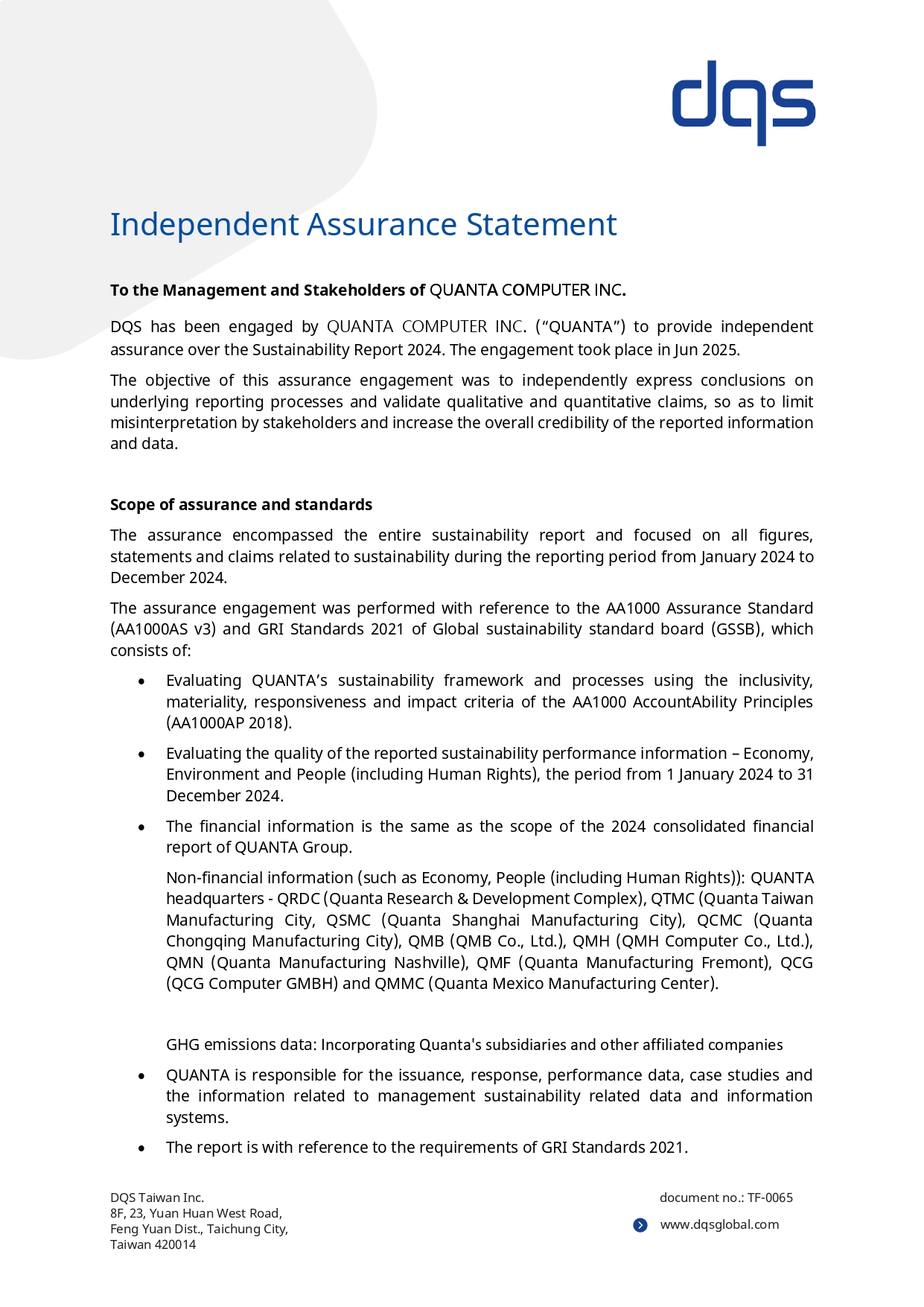
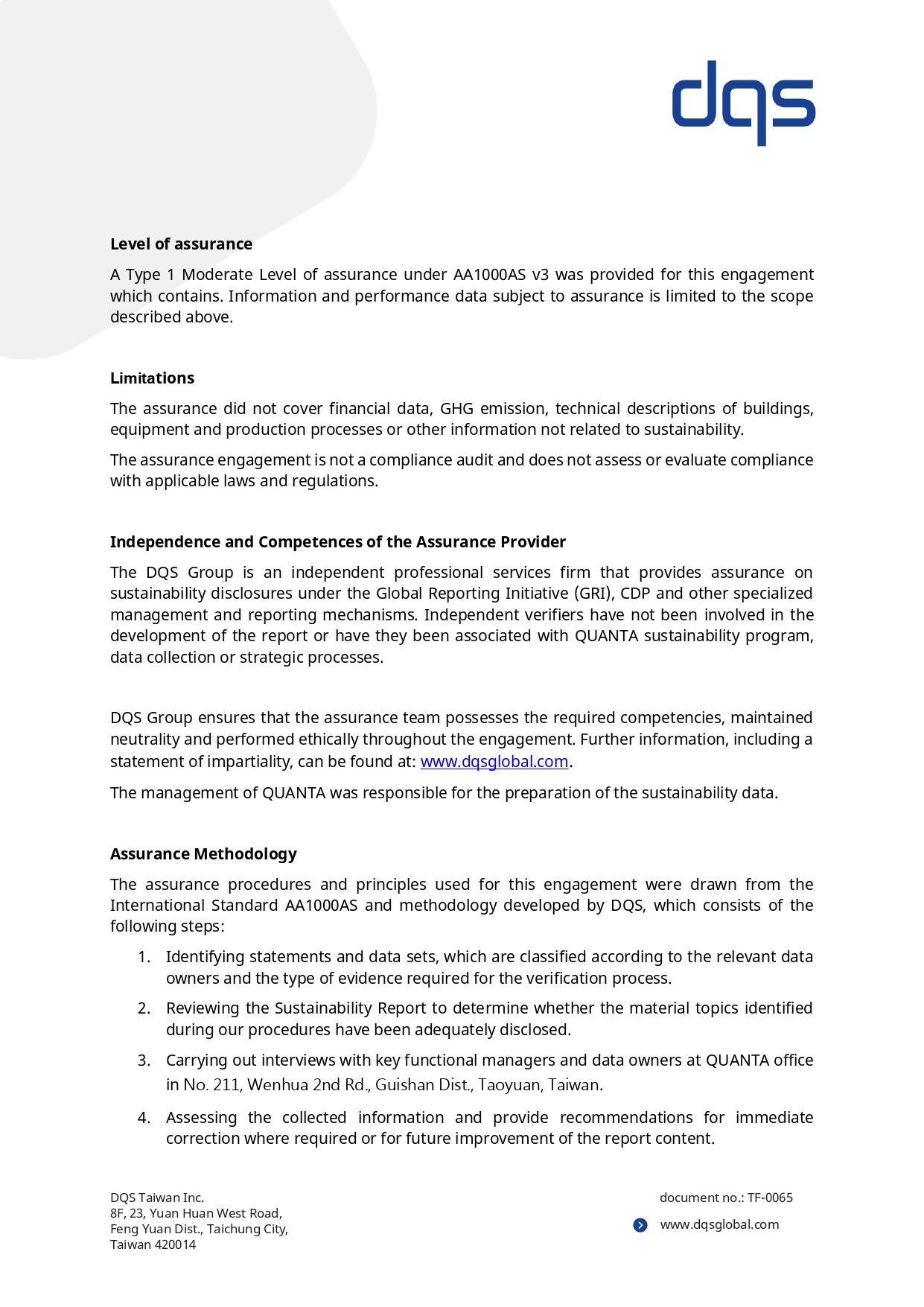
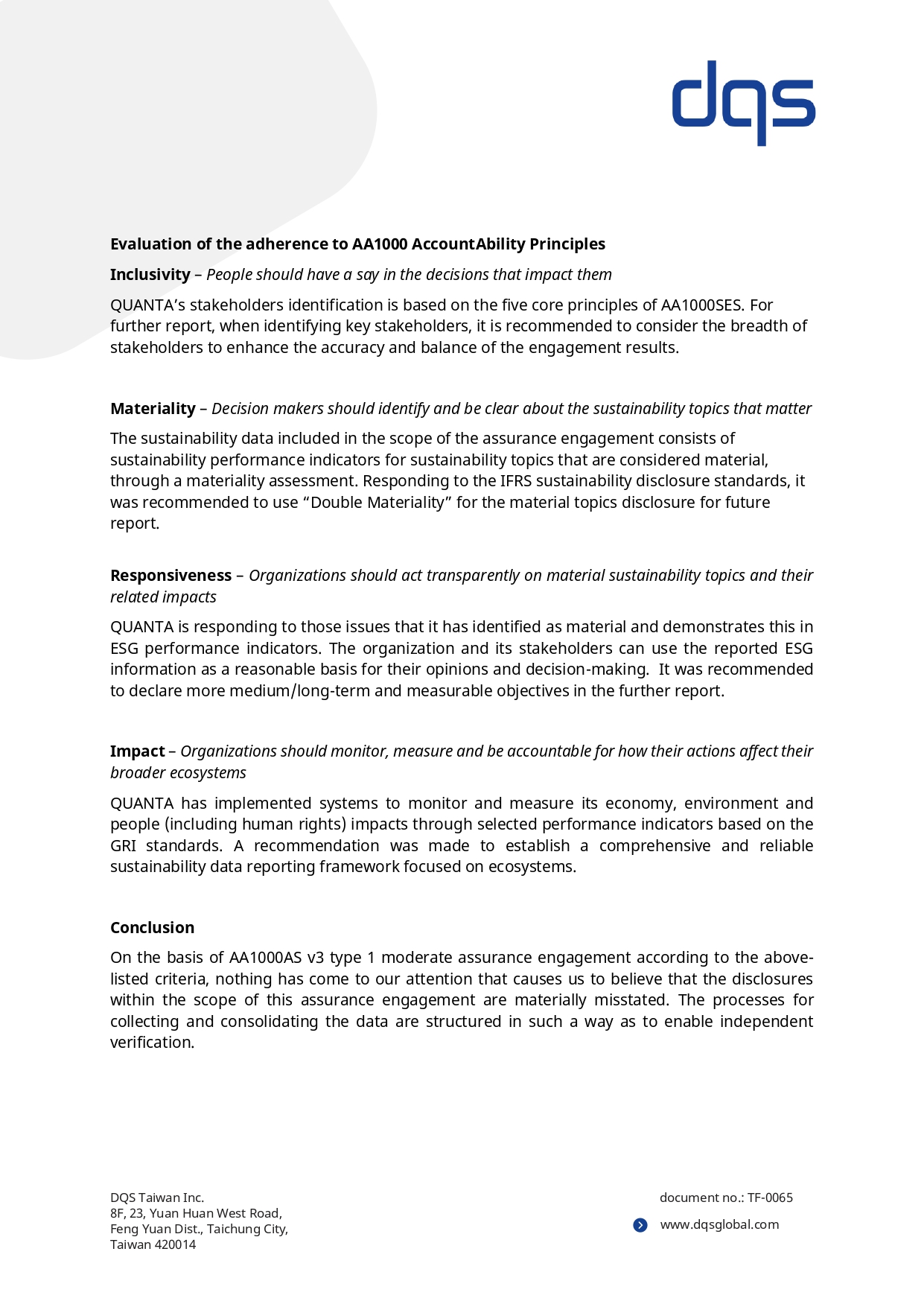
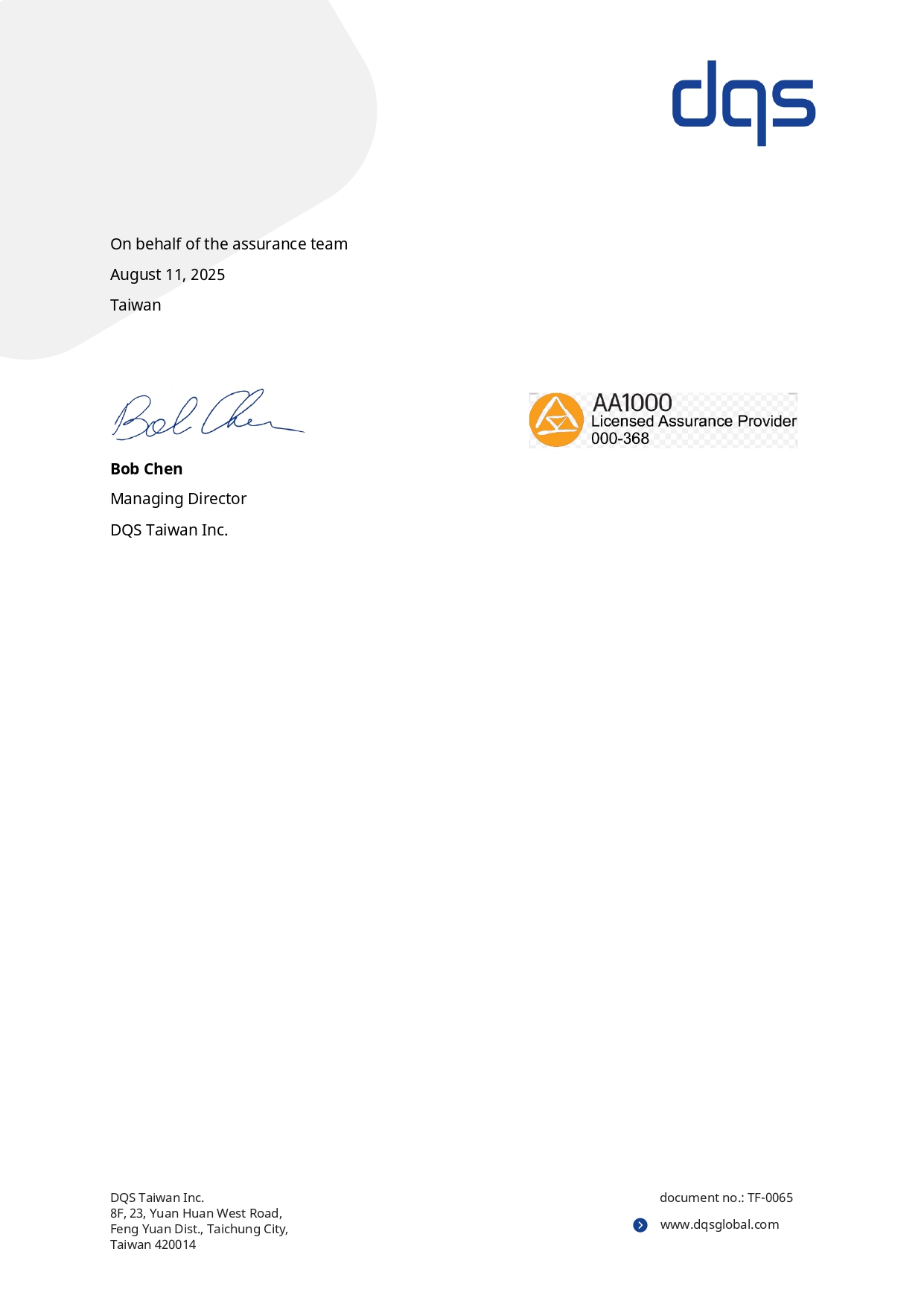
Independent Assurance Statement